

6 Persuasion Techniques to Make Your Landing Page More Effective
Landing page conversion depends not only on interface or design; psychology plays a major role. Apply persuasion principles at every customer touchpoint. Robert Cialdini's techniques have been a staple in marketing since they were first introduced.
In this article, you will discover what these techniques are. Many people are already aware that a landing page needs to showcase social recognition of a product. Here, you will learn about 6 persuasion techniques that will be useful for both beginners and experienced landing page owners.
The Principle of Reciprocity
This principle operates at the level of human instinct. Its essence is simple: if a person receives something for free, they feel a sense of obligation and will want to return the favor.
A Case from History
In 1985, Ethiopia allocated a significant sum to help earthquake victims in Mexico, despite facing dire conditions at home. This was a hidden way of repaying an old debt from 1935, when Mexico supported Ethiopia during the Italian invasion. Even 50 years later and in a difficult position, Ethiopia provided aid to Mexico because of the principle of reciprocity.
Of course, on landing pages, things are not quite as large-scale, but the principle remains the same. If your customers receive something for free, they will feel a moral obligation to thank you by making a purchase.
For example, BuzzStream allows users to download a file with useful promotion information for free and without registration, increasing the chances that a grateful user will fill out the form and leave their email address.
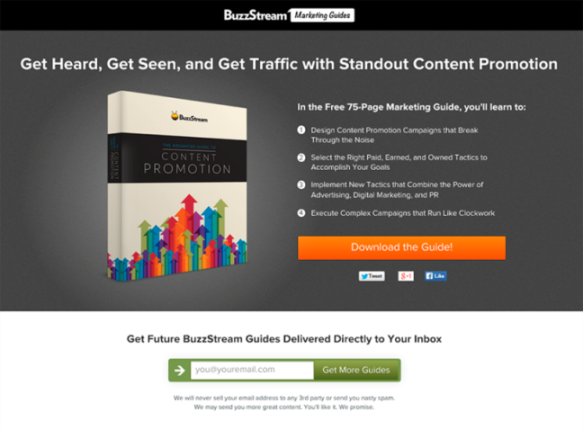
A marketer from BuzzStream reported that people who downloaded the file shared the link across various sources.
Apply this knowledge to your landing page as follows:
- First, offer a product or service for free.
- Then, offer something slightly more valuable in exchange for an action on your landing page.
The Principle of Commitment and Consistency
Most people take pride in being true to their word. Cialdini believes that commitment in any form is a powerful persuasion tool in itself. Members of society value consistency, even when the original reason may no longer be relevant.
For instance, in car dealerships, immediately after a test drive, the customer is brought back to the office to discuss contract terms. The first step is often asking the customer to state their own terms or confirm the manager's terms.
While this isn't official yet, the fact remains: a small commitment is still a commitment, and it can push you toward something bigger, like buying the car.
Here is an example of how the commitment and consistency principle was applied in the Obama campaign.
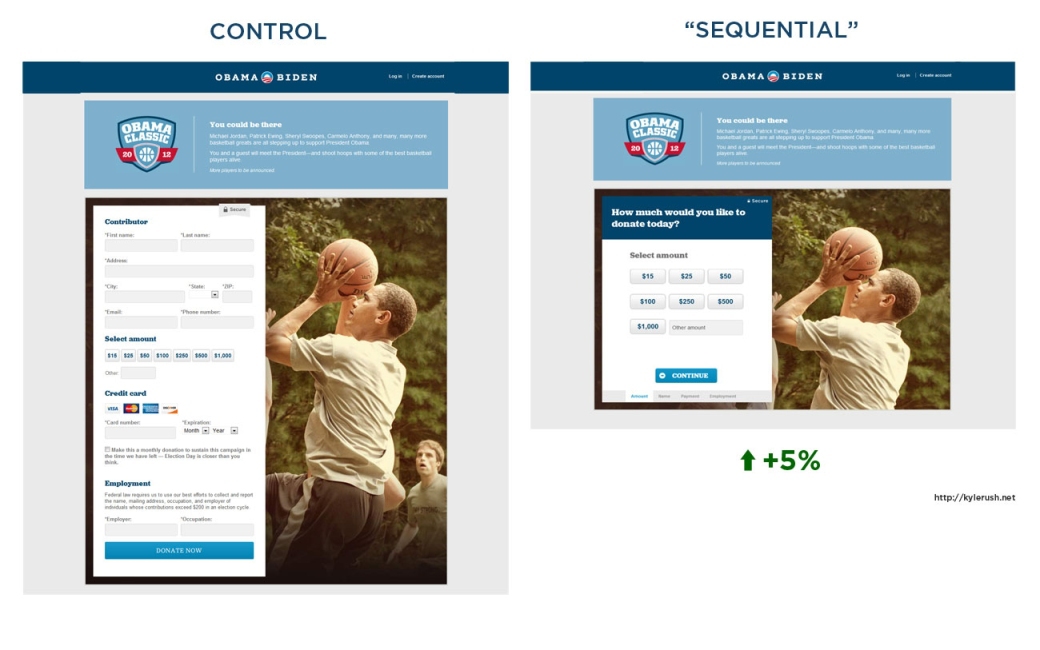
The principle was applied by creating a step-by-step donation process where the amount was specified in the first field. This created a commitment for the user, who then filled out the remaining fields with pride, viewing themselves as rational and prudent.
Use this on your landing page:
- Ask the visitor for a small commitment (e.g., checking a box).
- Break down the request into simple steps.
The Principle of Social Proof
The principle of social proof is built on the herd instinct—doing what others are doing.
In a door-to-door charity experiment, it was found that people were more likely to donate if they saw a longer list of previous donors, especially if they recognized names on it.
The flower delivery shop daFlores significantly increased its profits using social recognition. Before the changes, the banner displayed three random reviews.

After running experiments, it was noted that many users were unfamiliar with daFlores. That’s why the owners decided to make changes by highlighting their popularity. They replaced individual reviews with statistical data stating: “Thanks to our 600,000+ followers on Facebook!”.

Thanks to this simple solution, conversion increased by 44%. Apparently, when a visitor saw this, they realized that 600,000 followers couldn't be wrong. daFlores is clearly a great company providing top-notch services. That is the power of social recognition.
However, this principle has a dark side. If reviews look suspicious or fake, they won't increase conversion—in fact, they might decrease it.
Use this on your page:
- Use strong, authoritative testimonials from users within your target audience.
- Highlight popular products with special labels (e.g., “Best Seller”).
The Principle of Authority
Humans tend to obey authority figures. A striking example is the Milgram experiment, where subjects administered electric shocks simply because a person in a white coat—an authority figure—told them to. This technique is used with great success in sales across all industries.
Ultraviolet Digital managed to increase conversion for Kaya Skin Clinic by 22% using the authority method. They changed the text in the lead generation form.
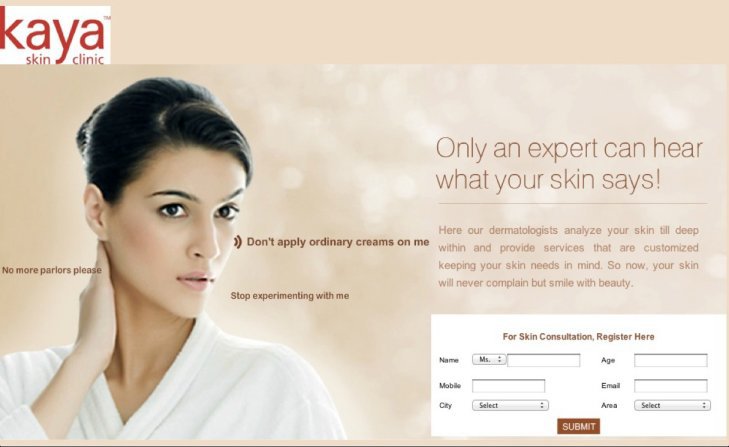
The opinion of an expert is the opinion of an authority. It was observed that the word “expert” itself helped increase sales. Therefore, the word was used a second time in the lead form: “I want to hear an expert opinion. Register me!” This time, the success exceeded all expectations, and sales increased by 137%.
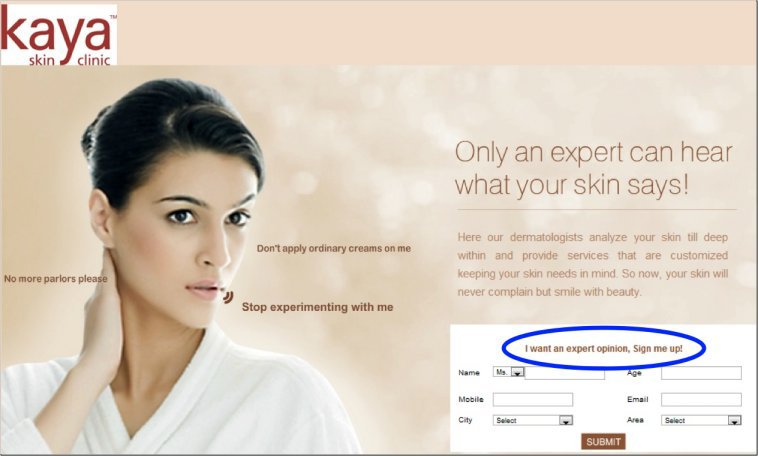
There was no mention of a specific individual specialist. The word “expert” did all the work.
Nevertheless, there is always room for improvement; the button text in this form could be made even more attractive.
How to apply the authority technique on your landing page:
- Quote experts and use information or news from authoritative sources.
The Principle of Liking
Cialdini believes that people are more likely to buy a product if they like the seller. The principle shows a tendency to value the opinions of people we find attractive or relatable. This technique doesn't fit every product and is the hardest of the six to implement online. However, that’s no excuse—increasing sales on your landing page using the liking principle is very achievable.
For example, Airbnb used this technique for a small, unknown platform and increased sales by 300%. Instead of a boring catalog, visitors were greeted by a smiling friend.
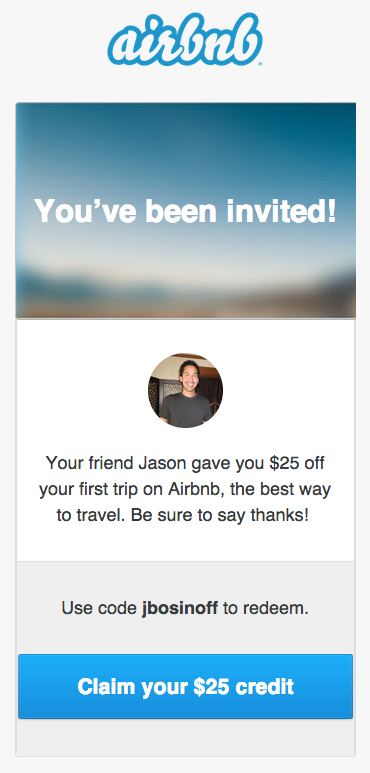
A similar example is Help Scout, which used a simple conversational writing style and a smiling person on its page. Humans are wired to like people with whom they share interests, problems, or experiences. Therefore, you should consider the factors that unite your target audience and use the liking principle to your advantage.
Use this on your page:
- Upload images of smiling people who represent your target audience.
- Use clear, friendly language in emails, texts, and instructions. The visitor should feel they are communicating with real, relatable people.
The Principle of Scarcity
Scarcity itself, whether real or artificial, creates a desire to buy quickly before it’s gone. Time limits force people to act.
For example, KISSmetrics shortened its free trial to 15 days, and conversion grew by 102%.
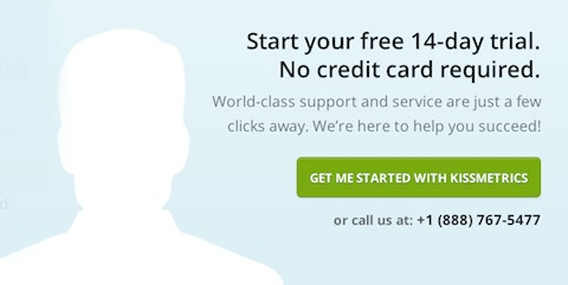
The increase in visitors boosted revenue because more people tested the product and purchased the paid package.
Quick Sprout applies this principle by using a countdown timer.
Limitation triggers the fear of missing out (FOMO).
How to apply the scarcity principle on a one-page website:
- Create an offer with a limited time or quantity.
- Use a countdown timer.
Remember, even small changes amplified by psychological techniques can boost conversion and significantly increase sales.


